 Funks Swabbie
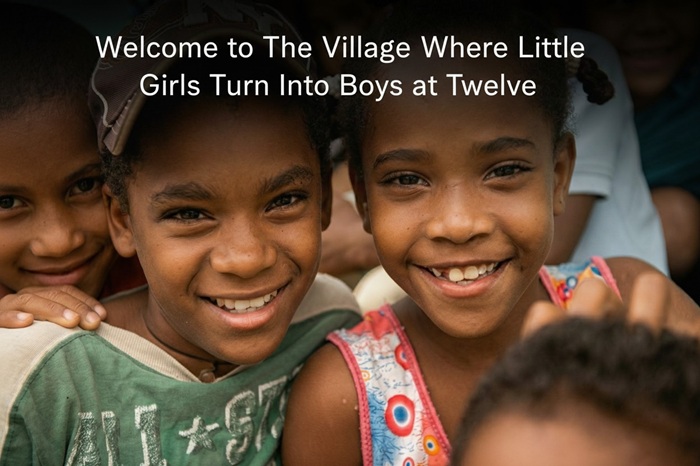
The headline might seem shocking, but it is absolutely true. There is a remote corner of the Caribbean called Las Salinas, a seemingly ordinary coastal village in the southwestern region of the Dominican Republic where girls turn into boys at the age of 12. This secret of Las Salinas defies conventional understanding of s3x and gender. Here, some children who appear to be girls at birth emerge as boys in their early adolescence. These children are known locally as Güevedoces, which means “p3nis at twelve.”
This is not myth or folklore. This is a real, scientifically documented phenomenon — a rare genetic condition that delays male genital development until puberty, when the body finally reveals its true course.
Origins of the “Güevedoces”
People first learned about the phenomenon in Las Salinas when outsiders visited to investigate rumors of children born female who later became male. In the 1970s, endocrinologist Julianne Imperato‑McGinley journeyed to Las Salinas and studied a cluster of such cases.
Imperato-McGinley’s research, published in 1974, traced the cause to a specific enzyme deficiency — a deficit in 5-alpha-reductase type 2 (5α-R2). This enzyme normally converts testosterone into a more potent hormone, dihydrotestosterone (DHT), essential for forming male external genitalia during fetal development. When the enzyme is missing or inactive, a genetically male (XY) fetus fails to develop a p3nis properly and is born with external genitalia that appear female or ambiguous.
Thus, while they carry male chromosomes internally, they are assigned female at birth based on appearance. However, at puberty — when the body surges with testosterone — their physiology catches up. The testosterone triggers growth of a p3nis, descent of the testes, deepening of the voice, increase in muscle mass, and other typically male secondary characteristics. Their external appearance shifts naturally to align with their chromosomal s3x.
Life as a Güevedoce: childhood, identity, and community
Children affected by this condition — while small in number — are known and accepted in Las Salinas. Their condition is not treated as a freak occurrence but rather as a recognized third-gender phenomenon.
As a child, a güevedoce is raised as a girl: with feminine clothing, a female name, and the social roles typical for girls in the community. One such person, “Johnny” (born “Felicitia”), recalled wearing little red dresses, playing with dolls, attending school in a skirt — yet even then, he felt uncomfortable. He preferred playing with boys and resisted the customs of girlhood.
Then puberty arrived. His male genitalia developed. His voice deepened. The transformation — physical, social, psychological — was unmistakable. After the change, many güevedoces identify and live as men. Their small size or lighter facial hair may reveal their unusual path, but by all other measures they assume male roles.
For many, the shift comes with a sense of relief and rightness. Growing up under the guise of a girl may feel constraining; at puberty, becoming male often feels like stepping into the place nature intended. “When I changed I was happy with my life,” Johnny reportedly said.
Biological explanation
Understanding why this happens requires a bit of biology. At conception, chromosomes determine biological s3x: typical males carry XY. During fetal development, the body produces hormones that sculpt the reproductive organs. For a male fetus, testosterone is converted by the enzyme 5α-reductase into DHT — the hormone that triggers development of a p3nis and scrotum.
But in individuals with 5-alpha-reductase type 2 deficiency, the enzyme is nonfunctional or missing. Consequently, their external genitalia do not develop along typical male lines. Many are assigned female s3x at birth because they look female externally. Internally, however, they have male testes and other male reproductive structures.
At puberty, the body’s surge of testosterone acts directly (without needing conversion to DHT), allowing genital growth and virilization. Secondary s3xual traits appear, and the person — biologically male — begins to look and function like any other man.
Medically, this condition falls under what is broadly described as “disorders of s3x development” (DSD). The shift at puberty, from female gender role to biological male, exemplifies one of the most remarkable natural variations of human development known to science.
Social, psychological, and cultural dimensions
For güevedoces themselves, the journey can be complex. As children they navigate a life incongruent with their biology: treated as girls while their inner sense and hormones might tell them otherwise. This can create inner tension — a sense of being miscast in a role that does not fit.
When puberty arrives, some embrace the change wholeheartedly. For them, the transition may affirm their identity, giving them a kind of clarity not previously possible. The physical changes often bring a relief after years of discomfort or dangling uncertainty.
But not all experiences are smooth. Some face teasing, mockery, or even bullying, especially during adolescence, when the physical divergence becomes more visible. For example, “Johnny” admitted that school life after his transformation carried stigma: classmates called him names, treated him differently.
Yet the village often treats the phenomenon as part of life. Güevedoces are not hidden or ostracized permanently; rather, their change is sometimes met with acceptance. In Las Salinas, their existence is woven into the social fabric.
Broader significance: science, medicine, and human diversity
The case of Las Salinas has drawn attention not only from medical science but from those interested in human diversity and the nature of s3x and gender. The initial discovery of 5-alpha-reductase deficiency helped clarify how hormones, genes, and development interact to shape biological s3x.
Moreover, the condition contributed to medical advances. The understanding of how DHT drives prostate growth led to development of drugs that inhibit 5-alpha-reductase — treatments for prostate enlargement and male-pattern baldness. Paradoxically, these modern medicines mimic the natural enzyme deficiency seen in güevedoces.
Beyond medicine, the phenomenon prompts deep reflection on how societies understand and assign gender. Güevedoces show that s3x and gender are not always rigid binaries. Nature itself offers variations — and communities sometimes adapt, embracing those differences rather than erasing them.
In a world increasingly debating gender identity and rights, the tale of Las Salinas feels surprisingly relevant. It challenges binary assumptions. It reveals how biological s3x, social gender, and personal identity may diverge and converge.
For human-rights advocates, it provides evidence that “male” and “female” are not always neat categories. For medical researchers, it demonstrates how genes and hormones shape bodies in unexpected ways. For ordinary people, it is a reminder of how human beings across societies deal with difference — sometimes with fear, sometimes with acceptance.
Finally, for anyone curious about the complexity of life, the Güevedoces stand as living proof of one of nature’s great experiments.
Over decades, the children of Las Salinas who undergo this transformation have grown into adults. Many live quietly as men, marry, work, and raise children. Their lives are not determined by sensational headlines. Most do not shout their story from rooftops. And many simply blend into the rhythms of Dominican village life.


 Funks Swabbie