 Funks Swabbie
Is there a tribe that rides reindeer?
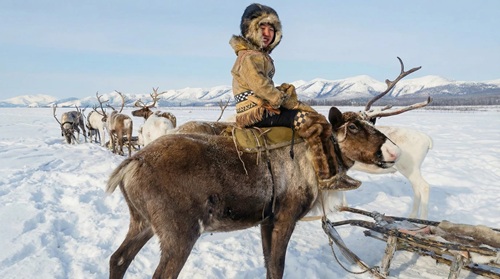
The simple answer is YES. Reindeer-riding is a common sight in the Arctic and sub-Arctic, where humans ride them. To get a clearer understanding, we must journey around the world’s rim in order to comprehend where people still ride reindeer, why they do so, and who they are. We shall see the Tsaatan of Mongolia, the Nenets and Evenki on the Siberian tundra, the Sámi in Fennoscandia, and other reindeer-herding tribes. We will also see cities and villages where reindeer are used as working animals to pull sleds, carry goods, and occasionally transport a rider to their jobs.
Reindeer herding is not a curiosity confined to postcards. It is a living livelihood spread across nine countries: Norway, Sweden, Finland, Russia, Greenland, the United States (Alaska), Mongolia, China, and Canada. Small reindeer herds are also kept in places like Scotland. Today roughly a hundred thousand people work with semi-domesticated reindeer in various systems of ownership, from family herds to cooperative districts. That geography means there are many towns and settlements where reindeer appear in traffic, at markets, and at ceremonial gatherings.
Who rides reindeer? The tribes and peoples of reindeer herding
Many Indigenous and local peoples maintain reindeer as part of their livelihood. The best known in Europe are the Sámi people, who live across Norway, Sweden, Finland, and the Kola Peninsula of Russia. In Russia, large reindeer-herding peoples include the Nenets, Evenki, Yakuts, and Chukchi. There are small groups in Mongolia and China, for instance, the Tsaatan, who are reindeer-raising Tuvan people in northern Mongolia. In Alaska and northern Canada, Indigenous peoples, including Inuit and some Athabaskan groups, use caribou and reindeer in their subsistence systems. The diversity is striking: these communities differ in language, law, herd size, and how much they rely on reindeer for milk, meat, transport, or trade.
Where do people ride reindeer?
The Sámi
The Sámi are probably the group most associated in international imaginations with reindeer. Reindeer herding for the Sámi is more than a job. It is a cultural practice bound to the siida, a traditional community grouping that manages pasture rights and migration. In parts of Norway and Sweden, laws reserve the right to herd reindeer to Sámi people. Herd sizes vary, and modern herding mixes snowmobiles, trucks, and traditional reindeer skills depending on region and household. Still, in many interior valleys and mountain pastures, a child might learn to lead a reindeer before they learn to drive a car.
The Nenets and Evenki
On the vast Yamal and Yamalo-Nenets tundra of northwestern Siberia, reindeer outnumber people. The Nenets have built a life on seasonal migration. Their territory is astonishing in scale, and their herds move between winter and summer pastures along established routes. On these routes, small settlements and administrative towns function as nodes where fuel, medical care, and supplies are obtained. On the open tundra a Nenets herder may be as likely to ride a reindeer as to push a sled. Climate changes and industrial development have compressed grazing lands and complicated the routes, but the human-reindeer bond persists.
The Tsaatan and other Mongolian herders
Farther east, in the taiga of northern Mongolia, the Tsaatan keep smaller herds. Their reindeer are central to movement through dense forest where wheeled vehicles have limited value. The Tsaatan are a small community, but riding reindeer has been part of their toolkit for centuries. Tourist interest in “living with nomads” has brought income and attention. That attention has value and risk in equal measure because it can alter delicate cultural balances.
Towns and settlements where reindeer meet roads and shops
There is no single “town of reindeer riders” like a theme park. Instead, towns at the edges of tundra and taiga—administrative centers, port towns, and rail stops—often share space with herding life.
In northern Norway, towns such as Kautokeino and Karasjok are Sámi cultural centers where reindeer and people cross paths in market squares, festivals and work. In Finnish Lapland, places like Rovaniemi host reindeer farms that both supply meat to regional markets and run tourist experiences. In Russia, administrative towns on the Yamal Peninsula such as Yar-Sale or Salekhard act as logistical bases for Nenets herding groups. In Mongolia, soums and district centers connect Tsaatan camps to larger trade networks. In all these places, reindeer are not only animals in fields. They are part of the traffic at the town edge and sometimes inside the town itself during rounding season, market days, or festivals.
Riding reindeer: how and why
Riding a reindeer is not the same as riding a horse. Reindeer are built for cold and long endurance. Historically, many northern peoples used riding harnesses adapted to reindeer anatomy. Saddles and stirrups were less common in some cultures; instead riders used blankets, packs or simple frames. The Evenki and some Siberian peoples developed padded saddles and techniques to sit comfortably on a lumbering, furry back. Reindeer carry people for short to moderate distances and excel in deep snow or boggy ground where wheeled traffic fails. In spring and autumn, during migration and rounding, herders sometimes ride to keep pace with the herd or to reach remote corrals. Where mechanisation took root, reindeer use declined, but it never disappeared. In places with limited roads, fuel scarcity, or cultural preference, riding remains sensible.
Modern pressures: law, climate and industry
Reindeer herding faces pressure from three directions. First, legal frameworks in Scandinavian countries, Russia, and other states shape who can own reindeer, where animals may graze, and how pastures are allocated. In Sweden and Norway, reindeer herding rights are sometimes limited to Sámi people in designated zones. In Russia, collectivization and later privatization created large state farms and then a messy transition. Second, climate change alters migration timing, forage availability, and the stability of ice that herders sometimes cross. Devastating heat events and unusual thawing have killed reindeer in recent years, with knock-on effects for herder survival and income. Third, industrial development—mining, pipelines, and roads—breaks migration routes and fragments pastures. These forces do not act in isolation. They shape whether reindeer remain a practical transport option and whether youth stay in the trade.
Tourism and the commodification of reindeer culture
There is money in reindeer. Meat, antlers, and hides are sold; reindeer experiences sell well to tourists. Farms near towns often run sleigh rides, educational sessions, and photo stops. Tourism can provide needed income, and it can encourage preservation of knowledge. But it can also pull communities away from subsistence rhythms and reframe animals as props. The best tourism practice is community led. In Norway and Finland, many Sámi enterprises are run by Sámi people who control the narrative and the economic benefits. In Mongolia and parts of Russia, outside operators sometimes dominate tours. Responsible visitors should seek community-run programs and respect seasonal timing and animal welfare.
Is there a single “tribe of reindeer herders”?
No. That question misunderstands the diversity of peoples who herd reindeer. There is an entire cohort of cultures and languages with reindeer as a shared economic thread. The Sámi are one group. The Nenets, Evenki, Yakut, Chukchi, Tsaatan, and others are distinct. Each has its own social structures, language, and history. Saying “the tribe of reindeer herders” erases that complexity. Reindeer herding is better thought of as a set of interlinked lifeways that appear among many Arctic and sub-Arctic groups.
Stories of people riding reindeer to work endure because they hold a paradox. On one hand, the image feels timeless: an ancient practice unchanged by time. On the other hand, each of those communities has adapted, negotiated, and modernised in distinctive ways. The sight of a reindeer in a town street will capture attention because it interrupts the promises of uniform modern life. For journalists and travellers, that interruption is a doorway into deeper questions about rights, resilience, and what it means to live in extreme climates.
If you want to see reindeer in use, go to administrative towns near herding regions: Kautokeino and Karasjok in Norway, Rovaniemi in Finland, Salekhard in Russia, or district centers close to Tsaatan camps in Mongolia. Expect the best encounters to be community guided rather than staged tourist shows. Respect seasons. Rounding and migration are busy and stressful times. Visiting during off-peak times for tourism is better for animals and herders.
Editor’s Note:
“Is there a tribe that rides reindeer?” Of course, the question has a concise, well-founded response: yes, and not just one. This is because Reindeer riding is still a way of life associated with employment, travel, and identity in the Arctic and sub-Arctic. It is not a novelty; rather, it is a component of an active livelihood system that spans nine nations, from Alaska and Mongolia to Scandinavia and Siberia. Tens of thousands of people still rely on semi-domesticated reindeer today for trade, transportation, food, and cultural survival.
Rather than uniting a single group of people, reindeer herding unites numerous different peoples. The Sámi people in northern Europe maintain reindeer according to traditional community structures that control seasonal mobility and grazing rights. They view herding as both an economic and cultural activity that is carried down through generations and supported by custom, language, and the law. A strong connection between humans, animals, and the environment is reinforced by the fact that children frequently learn how to handle reindeer before they even learn to drive.
Some of the world’s most extensive migratory systems are maintained in Siberia by large-scale herding societies like the Evenki and Nenets. With the help of centuries-old seasonal knowledge, their herds traverse vast tundra and taiga zones. Riding reindeer is still useful and effective, especially when migrating or in challenging terrain. It makes it possible for herders to travel through forests, swamps, and snow where cars either struggle or completely break down.
The Tsaatan maintain smaller herds that thrive in deep forests further south in northern Mongolia. For them, riding reindeer is more of a tool than a show. It facilitates travel between camps, herding, and hunting. Despite the additional revenue generated by tourism, the continued usage of reindeer is more a reflection of flexibility than nostalgia.
The natural integration of reindeer culture with contemporary life is among the most notable benefits. No “theme-park towns” of reindeer riders exist. As an alternative, actual towns like Kautokeino, Rovaniemi, and Salekhard serve as commercial centers where herders go shopping, trade, go to school, and get medical care. Reindeer are common in these areas, appearing in market squares and streets as part of everyday life rather than as tourist attractions.
Riding reindeer also emphasizes perseverance. In the face of industrial growth, legal pressure, and climatic change, these communities are still adapting. Reindeer are still useful in situations when fuel is limited, the terrain is unstable, or cultural knowledge provides better solutions than technology alone, even if snowmobiles and trucks are increasingly widely used. Because it continues to be effective, the practice endures.
Diversity is arguably the most beneficial lesson. There is a network of cultures connected by environment rather than identity, rather than a singular “tribe of reindeer herders.” Indigenous knowledge is not timeless, as seen by the many ways each community strikes a balance between tradition and change. Because it is still practical, significant, and profoundly human, reindeer riding persists and provides a potent illustration of sustainable life in harsh conditions.
