 Funks Swabbie
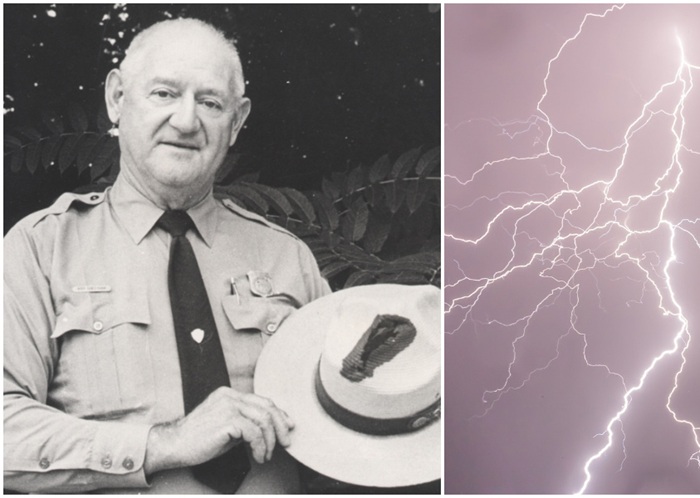
Roy Cleveland Sullivan was a tall, reserved man whom his colleagues said could sense a storm in a way that felt almost instinctive. Others believed the storms sensed him as well. Between 1942 and 1977, Sullivan became known worldwide as the human lightning rod, a title he neither wanted nor enjoyed. He was struck by lightning seven confirmed times during his work as a park ranger. Each strike could have taken his life, yet he survived them all. This is the story of a man whose life seemed to dance on the edge of nature’s fiercest force.
Early life
Roy Sullivan was born in 1912 in the foothills of the Blue Ridge Mountains, a region shaped by dramatic weather and steep terrain. As a child, he grew used to summer thunderstorms rolling across the sky with a deep rumble that rattled the wooden boards of his family’s home. He enjoyed exploring the forest long before he understood the dangers that lay within it.
Thunderstorms were an ordinary part of life in rural Virginia, yet no one imagined the strange role they would eventually play in Sullivan’s fate. People later wondered whether the landscape itself had been preparing him for what was ahead.
The First Strike: A Sudden Beginning (1942)
The first strike occurred when Sullivan was 30 years old. He had joined the National Park Service and was working in a lookout tower on top of a mountain. The structure had no lightning rod, a detail that would later prove crucial. A thunderstorm formed so quickly that he had no time to retreat. As he rushed to descend the tower, lightning struck the structure and jumped to him.
The bolt tore through his body, burning a line down his leg and exploding his big toe. It was a violent initiation into a phenomenon that would follow him for the rest of his life. Although he recovered, he returned to work with a new respect for the unpredictable power of storms.
At the time, no one imagined it was only the beginning.
The Second Strike: A Narrow Escape (1969)
Twenty-seven years passed before the next incident. On this day, Sullivan was driving through the mountains. Most people believe cars provide protection from lightning, but that is only true when windows are closed and the metal frame directs electricity to the ground. During this storm, Sullivan’s windows were open.
Lightning struck a nearby tree, bounced off and entered his vehicle. The bolt passed through him, knocking him unconscious and burning his eyebrows. His car continued rolling until it hit a ditch. When he regained consciousness, smoke drifted from his hair.
It was the second confirmed strike, and the odds of such a thing happening again were considered so small that the event was treated almost as a scientific curiosity. Yet nature was not done with him.
The Third Strike: Fire in the Air (1970)
A year later, Sullivan was again driving through the park when another storm broke over the mountains. This time the lightning struck a transformer near the road and leapt through the air toward him. The bolt set his shoulder on fire. He managed to stop the car and put out the flames with water.
Colleagues later remarked that he returned to work the next morning as if nothing unusual had happened. His calm reaction became part of his reputation. Sullivan did not consider himself brave. To him, each strike was simply an unfortunate consequence of spending so many years in the open forest.
The Fourth Strike: A Running Man (1972)
The fourth strike came while Sullivan was standing in an administrative building of the park service. Lightning hit a nearby electrical panel, traveled across the room and struck him. His hair caught fire again.
This was the moment Sullivan began to feel that something beyond ordinary chance was at play. He told friends that he started running whenever he noticed storm clouds forming. He believed that if he could reach a safe place quickly enough, nature might spare him. His colleagues joked gently about his fear, but none doubted that the streak of accidents was extraordinary.
The Fifth Strike: A Trail of Smoke (1973)
During a routine patrol in 1973, Sullivan noticed storm clouds building. He tried to drive away, but lightning found him again. This strike hit him directly and passed through his body with enough force to throw him from the vehicle. When he stood up, smoke rose from his hair and uniform.
The repeated injuries began to trouble him more deeply. He said he felt as though something was following him. Newspapers soon picked up the story, and he became known as “the human lightning conductor.” The unwanted attention made him uneasy, for he knew the public viewed his life through a mixture of awe and disbelief.
The Sixth Strike: A Familiar Fear (1976)
The sixth strike occurred while Sullivan was on another patrol. A cloud formed above him, and he tried to drive away quickly. The bolt entered the top of his truck and passed through him, burning his chest and stomach. Once again, he survived.
By this point, his fear of storms had grown severe. He often pulled to the side of the road and waited in his truck whenever clouds appeared. He even carried a bucket of water in the vehicle because lightning had set his hair on fire several times.
Still, he said he never considered leaving the job he loved. The forest had shaped him since childhood, and he refused to be driven away from it.
The Seventh Strike: A Final Encounter (1977)
The seventh and final strike came in 1977 while Sullivan was fishing. The sky had been clear at first, but a storm developed quickly. Lightning hit him on the head and traveled down his body, searing his chest and stomach. He managed to walk back to his truck and drive to a ranger station for help.
This last strike left him with burns but no permanent disabilities. Once again, he survived. No other person in recorded history has been struck by lightning so many times and lived to tell the story.
Scientists have long debated whether Sullivan was unusually prone to being struck. Some argued that his occupation placed him in exposed areas more often than the average person. Others noted that lightning tends to strike high elevations, metal objects and people carrying equipment.
Yet even with these factors, the likelihood of seven direct strikes remains extraordinarily small. The Guinness World Records recognized him for surviving the highest number of lightning strikes, a distinction he viewed with mixed feelings.
For Sullivan, the events were not a matter of fame. They were a source of lingering fear and confusion. He once said he felt as though storms were somehow aware of him.
Despite the repeated encounters with danger, Sullivan continued to live quietly. He retired from the National Park Service and spent his later years in Virginia, surrounded by family, neighbors and the familiar mountains where his life had unfolded.
Many people in the community admired his resilience. To them, he represented a rare kind of survival, not because he sought adventure but because he endured it when it appeared unbidden.
Sullivan died in 1983 from a cause unrelated to lightning. His story remains one of the most unusual chapters in American folklore and natural history.
To understand how these events were possible, it helps to examine how lightning behaves. A single bolt forms when electrical charges build up in the atmosphere and travel to the ground. The bolt seeks the shortest path, often striking the tallest or most conductive object in the area. Mountain peaks, steel structures, and open fields create ideal conditions for strikes.
Sullivan’s work placed him in precisely these environments. Lookout towers, forest patrols and isolated roads made him vulnerable. Each strike involved a chain of chance events. When considered individually, they seem strange but possible. When viewed together, they form an extraordinary pattern.
His survival can be attributed to several factors: quick access to medical care during some incidents; physical fitness; the nature of indirect strikes, which can be less lethal, and his ability to remain conscious long enough to seek help.
Today, Roy Sullivan’s story continues to draw interest from scientists, historians, and the general public. He represents a rare intersection between natural forces and human endurance. Many people find the story captivating because it seems almost mythic, yet it is fully documented and confirmed through medical records and eyewitness accounts.
His experiences remind readers of the unpredictability of nature and the fragile boundary between survival and catastrophe. Sullivan’s life was shaped by storms, yet he faced each one with steady determination. The quiet strength he displayed remains a defining part of his legacy.


 Funks Swabbie