 Funks Swabbie
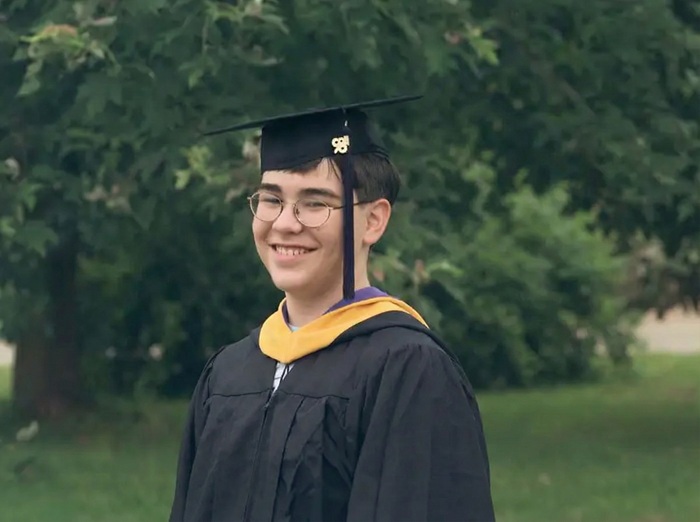
Even before earning his bachelor’s degree at 10, his parents knew he was special. This is the story of Michael Kevin Kearney, the 10-year-old boy who graduated from the university at the tender age of 10.
In any classroom, children tend to move at different rhythms. Some read faster, some solve numbers with ease, and others drift toward stories or songs. Teachers learn to guide these small differences, knowing most students follow a shared pattern. Every now and then, however, a child arrives whose abilities sit far beyond this pattern. These rare children solve problems that their peers may not encounter for years. They sense information as if it rises naturally from within.
Among such children, one name has remained remarkable for decades. It belongs to a boy who completed academic milestones at a pace that startled even seasoned educators. Before most children learn long division, he was finishing university-level coursework. Before many children write their first essay without guidance, he was earning a degree from a recognized institution.
Michael Kevin Kearney, and his story began in the early 1980s in Honolulu, where his parents had little reason to believe they were raising one of the most gifted minds of his generation.
A Childhood Marked by Early Signs of Genius
Michael was born in 1984. Unlike many child prodigies whose talents appear gradually, he showed an unusual alertness from infancy. Family members recalled his early speech, his quick memory, and his steady attention when adults spoke around him. These were faint signs at first, the kind that many families might dismiss as precocious behavior. But the signs grew stronger in the months that followed.
By the time he reached the age when most toddlers struggle to form basic sentences, Michael was communicating with clarity. He absorbed new words with ease and repeated information with surprising precision. His parents, Kevin and Cassidy, watched closely and tried to understand how to support their child. They did not want to rush him, but they soon realized his internal pace could not be matched by traditional expectations.
His mother took on the responsibility of helping him learn at home. She introduced reading materials and simple exercises that most children encounter in their first years of school. Michael consumed these lessons quickly, and when he advanced beyond them, she adapted to his needs.
The more he learned, the faster he progressed. Subjects that usually take years unfolded in months. Concepts that challenge many students became familiar territory for him long before he reached school age.
These early developments raised questions that his parents could not ignore. What would happen if they enrolled him in a traditional school? Would he be limited by a system not designed for children like him? After much consideration, they chose to continue home-based education. It allowed Michael to move at his natural speed, and it created an environment where learning felt steady rather than pressured.
Completing High School at Just Six Years Old
As Michael advanced through subjects, it became clear that he was not merely bright but operating at an academic level far beyond his age group. When most children are mastering simple arithmetic, Michael was already solving algebraic equations. When children his age were learning to read short stories, he was reading textbooks.
His mother created a structured curriculum, introducing science, mathematics, literature, and languages as soon as he showed readiness. The usual boundaries between grade levels dissolved. By the age of six, he had completed the academic requirements for high school.
This achievement raised a new challenge. Children who complete high school typically move on to college-level studies. But Michael was still six years old, an age when children spend more time on playgrounds than in lecture halls.
His parents sought guidance from educators and institutions. Some were hesitant, unsure if a university could admit such a young student. Others believed that if he could handle the material, his age should not stand in the way.
One of the institutions that recognized his ability was Santa Rosa Junior College in California. After reviewing his assessments, the college admitted him. Though the environment was unusual for a child, the focus remained on whether he could understand and complete the coursework. He did not merely understand it. He excelled.
Joining University Life at an Age When Children Learn to Write in Cursive
College classrooms are often filled with adults discussing complex ideas. Professors deliver lectures with assumptions about their students’ age, maturity, and background. When Michael entered these rooms, his presence drew natural curiosity. A small child sitting among university students is not a common sight. Yet his classmates soon discovered that he did not require special treatment.
He completed reading assignments with discipline and engaged with topics across different fields. Professors evaluated his work using the same standards as every other student. Some later described him as quiet, observant, and unusually committed to learning.
Because he could not yet drive or navigate certain tasks expected of older students, his family remained close by, supporting the logistical aspects of his education. The academic part, however, belonged entirely to him. He earned credits steadily and continued to explore subjects that caught his attention.
His time at Santa Rosa Junior College prepared him for the next major step in his education. Once he completed his coursework there, he enrolled at the University of South Alabama. It was here that he achieved the milestone that brought him international attention.
Earning a Bachelor’s Degree at Age 10
In 1994, at only ten years old, Michael completed the requirements for a Bachelor of Arts in Anthropology from the University of South Alabama. News of his achievement travelled widely. Newspapers covered his graduation, television programs interviewed him, and education experts discussed the significance of a child earning a university degree.
The university confirmed that his academic performance met all standards. He attended classes, completed assignments, passed examinations, and demonstrated full understanding of the material. His degree was not honorary. It was earned through genuine work.
At an age when most children learn multiplication tables, Michael had completed something that many adults find challenging. His achievement earned him a place in the Guinness World Records as the youngest person to obtain a bachelor’s degree.
Yet despite the attention, his family remained careful not to push him into an environment that could overwhelm him. Their goal was not fame but education shaped around his unusual abilities.
Continuing His Education With the Same Remarkable Speed
Some prodigies peak early and later fall into patterns similar to everyone else. Michael, however, continued to study at an impressive pace.
After completing his bachelor’s degree at ten, he pursued higher academic work. He earned a Master’s degree in Chemistry at age fourteen from Middle Tennessee State University. He later worked toward doctoral studies. His range of academic interests expanded into subjects including computer science, geology, and linguistics.
He also engaged with students and teachers of all ages, showing that intelligence does not need to be separated by age or confined to rigid categories. His experiences highlighted the value of flexible education paths, especially for children whose abilities do not align neatly with traditional grade structures.
Although much of the public conversation around Michael centered on his intellectual achievements, his life included more varied pursuits. He appeared on quiz shows and even won significant prizes for his knowledge. One of his most well-known appearances was on the program Gold Rush, where he earned a major cash prize for answering a series of challenging questions.
Despite the attention these achievements attracted, he maintained a private approach to life. As he moved into adulthood, he focused on building a career and maintaining a balanced lifestyle. People often expected him to follow a narrow path shaped by his early fame, but he continued to make choices that reflected his own interests rather than outside expectations.
His journey demonstrated that prodigious talent in childhood does not need to lock a person into a predefined future. Instead, it becomes one part of a larger and more personal story.
Even decades after earning his degree, Michael Kearney remains a figure of interest. Part of this interest comes from the sheer unusual nature of his achievements. But another part comes from what his life reveals about learning. Intelligence is not uniform. Curiosity does not grow at a steady pace. Some children show early signs of deep understanding, and when given the right support, they can accomplish remarkable things.
The story of a ten-year-old university graduate is uncommon, but it is also a reminder that human potential often stretches far beyond expected limits. Families, teachers, and policymakers continue to examine his path to understand how future gifted children might be supported.
As adults look back on his childhood, the central theme remains consistent. His journey was not defined by pressure or competition, but by a steady and guided effort to meet him where he stood. His parents created an environment that nurtured learning rather than forced it. Educators recognized his ability and offered opportunities. That combination allowed him to move at a pace that belonged uniquely to him.


 Funks Swabbie