 Funks Swabbie
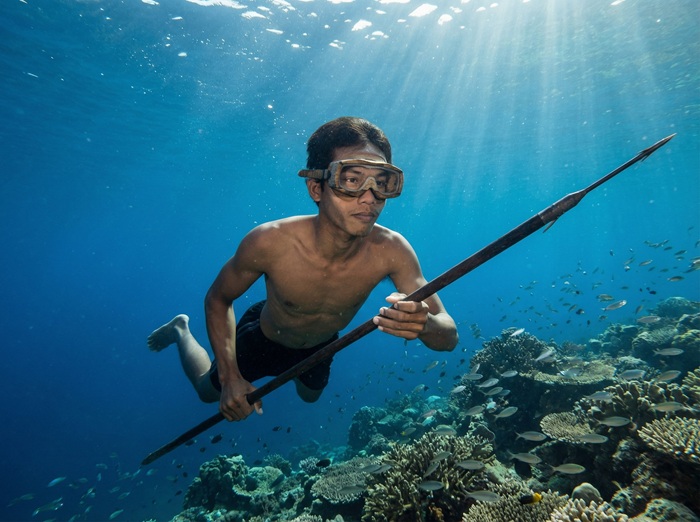
The Bajau people live along coastlines and islands of Indonesia, Malaysia and the southern Philippines. These sea people are known for holding their breath underwater for several minutes.
For centuries, these islands scattered across the waters of Southeast Asia have been ringed by boats that look less like shelter than like entire floating villages. On those decks and in those stilthouse communities live the Bajau — a constellation of maritime groups (often called Sama-Bajau) whose lives are threaded through the sea. They fish, trade, raise children and tell stories from platforms built above shallow reefs. They are also famous for another reason: many Bajau free divers routinely descend beneath the waves without tanks, spears in hand, and return with prey — and with a breath still in their lungs long after most people would resurface gasping.
Over the last decade researchers have asked whether this lifestyle shows up in the Bajau body itself, and whether genes, anatomy and training combine to make them unusually efficient breath-holders. Evidence points to a complex mix: learned skill and an ancient habit of diving, amplified by physiological traits that help survive low-oxygen episodes. The result is a people whose relationship with the ocean rewrites assumptions about what the human body can do under pressure.
History and livelihood
The Bajau are not a single, uniform tribe but a network of communities found along coastlines and islands of Indonesia, Malaysia and the southern Philippines. Many Bajau traditionally lived on boats or in stilted houses above reefs and lagoons. Fishing — by free diving, spearing, and gleaning the seafloor — is the backbone of daily life. Children often learn to swim and hold their breath almost as soon as they can walk; diving is practical, not recreational. The Bajau harvest fish, octopus, sea cucumber and other marine resources that can only be reached beneath the surface, and this work often requires repeated dives lasting minutes at a time.
The sea shapes language, ritual, food, trade and kinship. Whole livelihoods pivot on diving skills. Where modern economies have reached their shores, some Bajau communities have traded boat-life for shore settlements, but freediving remains central to cultural identity. Photographs and oral histories from ethnographers show parents handing simple masks and spears to children on coral flats; elders still tell of days when families lived entirely on the water. These are not isolated anecdotes: anthropologists and journalists have documented the Bajau’s underwater work for decades.
How long can they stay down?
Popular reports sometimes overstate single feats — it is common to find headlines claiming Bajau can hold their breath for “10 to 13 minutes” or dive to extraordinary depths. Context matters. Elite freedivers (trained athletes using hyperventilation and specialized techniques) have posted remarkable breath-hold records. For the Bajau, the pattern is repeated, practical diving rather than single staged records. Many Bajau divers routinely make multiple dives per day, some reaching depths of tens of meters and staying under for minutes. Researchers who measured breath-hold times in field studies found values that far exceed typical untrained populations, but claims of 10–13 minutes are exceptional and not representative of everyday dives. Reliable scientific studies emphasize adapted physiology rather than headline-grabbing maximums.
What the science found
A landmark study in 2018 combined physiology, ultrasound imaging and genomics to compare the Bajau with neighboring non-diving groups. The study reported two main findings that attracted wide attention.
First, Bajau divers were found to have larger spleens on average — roughly 50 percent larger than the comparison group in that sample. The spleen functions, among other roles, as a reservoir of oxygen-rich red blood cells. When it contracts (a normal response to diving or stress), those extra stores are released into circulation, giving tissues a temporary boost of oxygen. For people who make repeated breath-holds and dives across a day, a larger spleen can extend underwater time and improve recovery between plunges.
Second, genomic scans turned up signals of selection in genes linked to spleen size and the diving response — notably variants in the PDE10A gene and evidence for selection on BDKRB2, a gene that influences the diving reflex. The researchers interpreted the pattern as suggestive that long-term exposure to a diving lifestyle favored genetic variants that support superior oxygen management. That interpretation is careful: genetics is only one piece of a larger puzzle that includes training, culture and environment. Still, the study offered the first compelling evidence that human populations may have genetically adapted to an aquatic niche.
Two physiological mechanisms are central to breath-hold diving:
The mammalian diving reflex. When the face is submerged in cold water, the body triggers a coordinated response: heart rate slows (bradycardia), blood vessels in the limbs constrict, and blood is preferentially routed to the heart and brain. This conserves oxygen for vital organs during apnea. Humans possess this reflex to varying degrees; habitual freedivers and some sea peoples show stronger, more rapid responses.
Splenic contraction. The spleen stores red blood cells and can eject them into circulation when signaled by stress or apnea, increasing oxygen-carrying capacity for several seconds to minutes. A larger spleen enlarges the reserve pool. Field and lab data show that trained divers can trigger more forceful spleen contractions, and that populations with habitual diving lifestyles may have larger spleens at baseline.
Together these mechanisms reduce oxygen use and extend the time tissues can function without fresh inhaled oxygen. For Bajau divers who descend repeatedly and rely on quick recovery between dives, even small advantages compound into major practical benefits.
Training, culture and bodily skill
Physiology alone does not explain everything. The Bajau’s early, lifelong exposure to water builds skill and resilience. Ongoing practice teaches efficient breath management, relaxed swimming, and mental strategies to resist panic. Children who spend hours in the shallows grow different muscle memory and breath-control reflexes than children raised away from the sea.
Moreover, the everyday rhythm of Bajau life — multiple short dives, plus occasional deeper forays — conditions cardiovascular and metabolic systems. It is reasonable to see the Bajau as a population where culture and biology have co-evolved: customs that require diving shaped behaviors that, over generations, could influence selection pressures on genes affecting oxygen handling. The 2018 study’s genomic signals are consistent with that view.
Working the sea is physically demanding and also dangerous. Repeated deep breath-hold diving increases risks: barotrauma (pressure-related injury), decompression sickness (in some dive profiles), hypoxic blackouts, and chronic ear or sinus damage. The seaside life is not static either: coastal development, overfishing and legal marginalization have pushed many Bajau off traditional routes and into shore-bound economies or precarious urban life. That upheaval changes both exposure to diving and access to healthcare.
Medical researchers urge caution in romanticizing breath-hold adaptations. Larger spleens and genetic signals are intriguing, but they do not make a population invulnerable. Hypoxia remains hazardous. Interventions that help include education about safe diving practices, access to medical care, and legal protection for traditional livelihoods.
The Bajau example is a reminder that human bodies are not frozen templates. When people live in a specific niche for generations, physiology and selection can shape small but meaningful differences. The Bajau’s larger spleens and stronger diving reflexes — combined with skill and culture — illustrate how lifestyle and biology can intertwine. This does not mean genetics predetermine destiny. Rather, in some environments, inherited traits and practiced abilities reinforce each other to expand human capability.
For scientists, the Bajau case opened new questions: which other human groups show niche-specific adaptations? How much of freediving skill is learned versus inherited? Could medical research learn from these adaptations to help people with hypoxia-related conditions? These are active research avenues, and the answers require careful study, community engagement and respect for the people who, in many cases, did not set out to be research subjects but simply want to keep living from the sea.
Travel writers and documentary photographers who have lived among the Bajau tell of mornings when whole families wake before dawn to set nets, of grandparents teaching grandchildren to read the currents, and of the quiet, steady rhythm of a people so intertwined with the sea it shapes their rhythm of sleep, work and ceremony. These accounts are valuable reminders that scientific studies add detail to human stories, but do not replace the voices of the people themselves.


 Funks Swabbie