 Funks Swabbie
Alia Sabur made history in February 2008 by becoming a professor at the age of 18. This is the story of how an unusually gifted child became a global symbol of potential, ambition, and youth-driven excellence. It is a tale of fierce intellect, determined parents, and the kind of promise that challenges what many accept as possible.
How It All Started
Alia Sabur was born on February 22, 1989 in New York City. From early days, her mind seemed to move faster than the world around her. According to those who observed her as a child, she began to read at an exceptionally young age — some accounts suggest she could identify and understand letters and words almost as soon as she could see.
In elementary school, routine lessons held no challenge for her. As a first-grader, she reportedly “tested off the IQ scale.” By fourth grade her family decided to pull her from public school and seek a more fitting path. Her academic journey was no longer going to be ordinary.
At age 10, while many children her age struggled with basic middle-school math and friendships, Alia was admitted to Stony Brook University. Her admission did more than raise eyebrows — it began to challenge long-held ideas about ability, age, and education.
From College Student to Graduate at 14
Entering college at 10 is rare. Completing college before many begin high school is almost unheard of. Yet Alia did both. Over four years, she immersed herself in rigorous coursework, balancing advanced mathematics and science classes while her peers lived ordinary childhoods.
At 14, she graduated from Stony Brook University summa cum laude with a Bachelor of Science in applied mathematics. She became one of the youngest people — and the youngest female in U.S. history at the time — to complete such a degree.
But the degree was only one milestone. It was a testament to how early promise — properly nurtured — can outpace expectation.
Master’s, Ph.D., and Beyond
Not content with early success, Alia moved forward. She enrolled in Drexel University in Philadelphia for graduate studies in Materials Science and Engineering. By 2007, she had completed her Ph.D., marking another significant milestone — though not yet the most sensational.
Her academic credentials were now full: a bachelor’s, a master’s, and a doctorate — all well before most people finish college. For many, this would be a lifetime of achievement. For Alia, it was preparation.
February 19, 2008: The Day History Was Rewritten
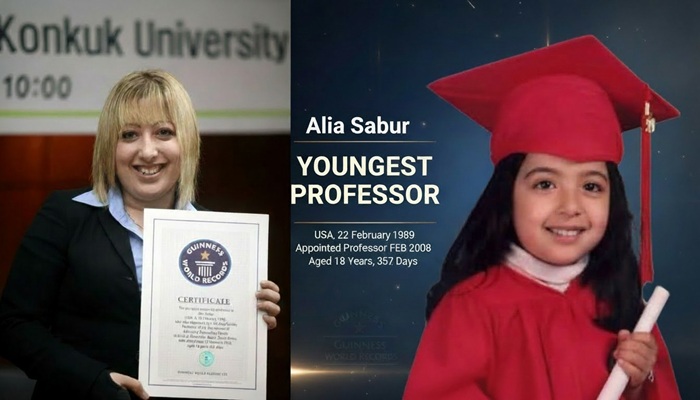
On that date, when Alia was 18 years and 362 days old, something remarkable happened. She was appointed as a full-time faculty member at Konkuk University in Seoul, South Korea. Her role: Professor in the Department of Advanced Technology Fusion. She was also to serve as Research Liaison with her alma mater, Stony Brook University.
The appointment made global headlines. Institutions, educational commentators, and media outlets celebrated the news. A record once held since 1717 — when Colin Maclaurin became a professor at 19 — had finally been broken.
On a quiet afternoon in June 2008, Alia stepped in front of over 200 students in a hall at Konkuk University. At 18, she stood before learners many years older than herself and began lecturing on nanomaterials and their applications. For most, she’d be a bright first-year undergrad. For them, she was professor.
In that moment, age became a number. Talent, training, and relentless pursuit became proof that capability does not always travel on a fixed timetable.
Inside the Lecture Hall: The Unusual Classroom
Imagine sitting in a university lecture hall. A young figure, almost childlike, walks to the lectern. The semester begins. The subject: advanced technology fusion — a field that merges materials science with engineering, potentially at the cutting edge of nanotechnology.
For many in the audience, it could have felt odd. Students accustomed to older, seasoned professors now looked up at someone who had only recently celebrated her eighteenth birthday. Some may have wondered: can she lead a class? Does she know enough?
Alia handled skepticism with quiet confidence. She prepared rigorously. Her academic track record — BS at 14, PhD at 18 — spoke louder than preconceived judgments. On that first day, she began explaining nanomaterials, cellular probes, and emerging possibilities. The words were not simplified. The concepts remained challenging. But the delivery was clear. The ambition palpable. And by the end, many sitting in that hall would realize they were part of something extraordinary.
Faculty members at Konkuk reportedly reviewed her credentials carefully. Her appointment stood on merit, not novelty. As far as the official record goes, she was a full-time professor — not a guest lecturer, not an intern. That clarity turned her story into more than a sensational headline. It became a legitimate chapter in academic history.
The Talents Beyond the Books
Alia’s brilliance was not limited to equations and theorems. Her childhood home was filled with books, but also with music. By age 11 she had already made a solo debut as a clarinetist. Her ability extended beyond the laboratory. She balanced intellectual intensity with musical artistry — a rare blend often lost in stories of prodigies.
Moreover, she was physically active: at nine she earned a black belt in Tae Kwon Do. These achievements — academic, artistic, physical — portray a person not confined to a single dimension.
When she accepted the role at Konkuk, she spoke not of fame, but of opportunity. She spoke of inspiring young people, of contributing to research that may one day benefit humanity. “I want to do research that can be used for the benefit of people,” she told reporters.
Extraordinary stories often hide challenges beneath the glow. For Alia, the pressure of expectation would not wait until she reached middle age — it came with her first identity as “the youngest professor.”
At 18, she was thrust into a world where colleagues looked older, experience mattered, and scrutiny followed every decision. Some media outlets questioned whether a teenager — even one with such credentials — could manage the social, emotional, and professional load. Others admired the boldness.
Later, her journey took unexpected turns. She did not remain long in that first professorship. Her contract was temporary and she chose not to renew it. In subsequent years she stepped away from academic teaching and shifted her focus. Some sources suggest she moved toward intellectual property law, using her scientific background in a different arena.
Whether by choice or by circumstance — or some combination of both — Alia’s path after fame shows that early success does not guarantee a linear future. It shows instead the complexity of balancing expectation with personal growth.
For many young people — especially those who feel out of sync with traditional schooling — her story offers hope. It says: perhaps you’re not behind. Perhaps you simply move differently.
For educators, it offers a lesson: rigid systems may overlook exceptional talent. Flexibility, support, encouragement — these may matter as much as curricula.
For the rest of us, it offers wonder. A reminder that human potential can sometimes redefine expectations.
A Timeline of Key Milestones
| Year/Age | Milestone |
|---|---|
| 1989 | Alia Sabur is born in New York City. |
| ~1990s (infancy) | Early reading ability; reportedly learned letters and words precociously. |
| Age 9 | Earns a black belt in Tae Kwon Do. |
| Age 10 | Enters Stony Brook University. |
| Age 14 | Graduates summa cum laude with B.S. in Applied Mathematics — one of the youngest in U.S. history. |
| 2006–2007 | Completes M.S. and Ph.D. in Materials Science and Engineering at Drexel University. |
| February 19, 2008 (age 18 years 362 days) | Appointed Professor at Konkuk University, Seoul — recognized by Guinness World Records as youngest professor ever. |
| June 2008 | Begins lecturing at Konkuk University. |
| 2009 (approx.) | Declines to renew contract; later moves toward other career paths. |
What Happened Afterwards — The Path Beyond the Records
Alia Sabur’s record-breaking appointment was not a permanent job. According to public records, her position at Konkuk University was initially a one-year contract and she chose not to renew it.
Following that period, she shifted direction. Sources suggest she moved into the field of intellectual property law, combining her scientific background with legal studies — a path far from the lecture halls but still rooted in her earlier training.
Her journey after academia shows that being a prodigy does not necessarily mean a traditional academic career. It means many possible roads.
In interviews a few years later, she reflected on her experience with candor. She spoke about the pressure, the social challenges, and the burden of expectation. She also spoke about how she gained perspective, exploring fields beyond science, reconnecting with everyday life, and shaping identity beyond “youngest ever.”
Her story remains important not only because of what she did, but because of what she represents: a bridge between possibility and reality.
In a world that often measures achievement by age-appropriate milestones — high school at 18, college in early 20s, graduate degrees in mid-20s — Alia Sabur’s journey defies the template. Her story resonates with anyone who has ever felt out of sync with conventional schedules. It reminds educators and policymakers that flexibility may unlock hidden brilliance. It challenges parents to look beyond grades and age groups.


 Funks Swabbie