 Funks Swabbie
This is the fascinating story of how a young girl became known as the next Albert Einstein. Imagine a young girl, curious and determined, tinkering with nuts, bolts, and metal panels in her family’s garage—building not a toy, but a real airplane. For Sabrina Gonzalez Pasterski, that childhood project marked the beginning of a journey the world would soon watch. Born in Chicago to a Cuban-American family, Sabrina has been described by leading institutions and observers as “the next Albert Einstein.”
Her path stands as one of rare brilliance: at age 14 she completed building a functioning single-engine aircraft; at 16 she flew it solo over Lake Michigan — despite being younger than many teenagers eligible for a learner’s permit. From those early days, the world began to take notice.
Today, her work dives deep into the most abstract realms of physics—black holes, spacetime, and quantum gravity—crafting theories that attempt to describe the fabric of reality itself. In doing so, she occupies a space once held by titans like Einstein and Stephen Hawking.
Her story combines youthful wonder, disciplined learning, bold experimentation, and scientific ambition.
From Garage Hangar to Physics Labs: Early Years
Sabrina’s fascination with flight didn’t start in a lab or a classroom. It began during her childhood when a first flight inspired wonder. By age ten, she was building an airplane engine. By twelve, she’d begun assembling a full single-engine plane from a kit.
Those who know her often mention how unusual — and bold — this ambition was. Many teenagers struggle with homework; few attempt to build something that flies. Even fewer succeed. For Sabrina, mechanics and physics were not abstract ideas; they were parts and motion, lift and thrust, metal and math.
At fourteen she completed the aircraft. For a teenager, it might have been considered a remarkable hobby. For Sabrina, it was a milestone. She then piloted the plane solo — a real flight.
This remarkable feat caught the attention of people beyond her hometown. Professors at Massachusetts Institute of Technology (MIT) saw a video she posted online showing her work on the plane. Despite an initial wait-list at MIT, her project convinced them she was more than a gifted student. She was a maker. A doer. Someone capable of bridging theory and practice.
Entering MIT, Sabrina carried a reputation — not just as a precocious student, but as someone with hands-on engineering experience and a passion for understanding physical laws.
Academic Stardom: MIT, Harvard, and Early Recognition
At MIT, Sabrina did not follow a typical four-year undergraduate path. She completed her physics degree in three years — and graduated at the top of her class, earning a 5.0 GPA. That achievement alone would define excellence for many. For Sabrina, it was merely one step on a longer journey.
Soon after, she moved on to Harvard University for advanced study. By her early twenties she was already working as a doctoral candidate in physics — a rare position for someone so young.
Media and academic circles began calling her the “next Einstein.” That praise does not come lightly. It reflects not only brilliance, but a combination of early achievements, bold ambition, and an emerging record of research. Forbes, Scientific American, and other publishers included her in lists celebrating top young minds.
Her story also quickly became symbolic. A young woman, from a minority background, succeeding in a field where few share her identity. Her success resonates with students who dream of science, engineering, and theoretical physics — especially girls and underrepresented groups seeking validation that brilliance knows no gender or nationality.
Venturing Into the Unknown: Physics at the Edge of Understanding
Rather than following safer or more conventional physics career tracks, Sabrina gravitated toward some of the most challenging puzzles in theoretical physics: quantum gravity, spacetime, black holes, and the unification of physical laws.
These are topics that have challenged physicists for decades. They demand not only mathematical skill, but imagination, resilience, and willingness to admit how much remains unknown. In that sense, Sabrina’s choices reflect more than ambition — they reflect daring.
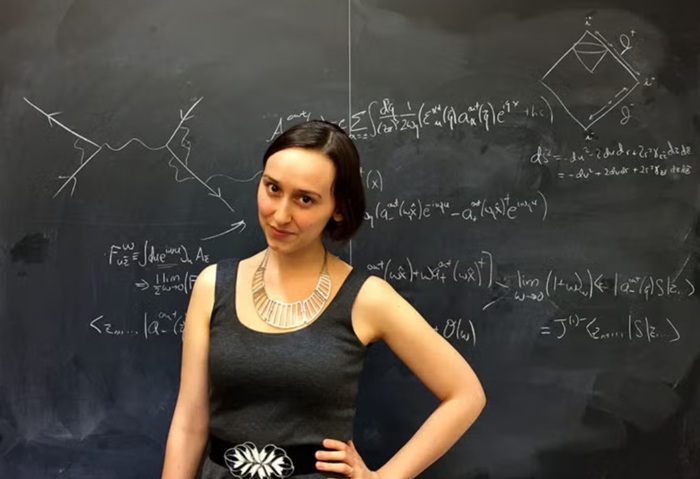
Her doctoral work at Harvard involved studying scattering in asymptotically flat spacetimes and investigating how a lower-dimensional conformal field theory (CFT) might describe gravity in a flat background — a cutting-edge area in modern physics.
Such ambitious research has already drawn serious attention. Some of her research contributions were cited by prominent figures — a sign that her work is being taken seriously in elite circles.
Her mentors and peers at Harvard reportedly granted her significant freedom to explore her ideas — a rare privilege for a young scientist.
Beyond Academia: Outreach, Representation, and Inspiration
Sabrina seems aware of the symbolic weight she carries. As someone described as “the next Einstein,” her visibility extends beyond physics journals. She serves as a role model for girls, especially those from minority communities, who dream about STEM careers.
Her journey demonstrates that ambition, curiosity, and hands-on passion can coexist — that someone can build real, working machines and also pursue the mathematical depths of the universe. That duality — combining craftsmanship and theory — echoes some of the great polymaths of history.
This image is powerful because it expands the idea of who can be a physicist. In a world often shaped by stereotypes and limited expectations, Sabrina’s life suggests that brilliance is not bound by background — but by determination, opportunity, and support.
Critique and Caution: Why “Next Einstein” Is Both an Honour and a Burden
While the label “next Einstein” brings visibility and admiration, it also carries weight. It sets expectations — not only for breakthrough discoveries, but for a long and impactful career. Physics, especially theoretical physics, does not promise fast success. Many ideas take years or decades to test; many promising researchers never change textbooks.
Moreover, comparing any living scientist to a legend like Einstein risks oversimplifying both the living person’s work and the legend’s uniqueness. Each era has its challenges. Each scientist approaches problems with different tools, cultures, motivations.
Yet calling Sabrina “the next Einstein” isn’t just about hype. It reflects a recognition that she combines rare qualities — early engineering skill, academic brilliance, powerful curiosity, and work on deep physical questions. It is acknowledgement, not prophecy.
Whether she ultimately transforms physics remains to be seen. But the fact that her peers, mentors, and even critics take her work seriously speaks of potential — and that, in itself, is notable.
Challenges Ahead — And What They Reveal About Science Today
Sabrina’s path remains fraught with challenges. Theoretical physics is a territory of uncertainty. Not every hypothesis withstands test; not every promising research leads to a breakthrough.
Her work involves complex mathematics, intricate peer review, and long hours. She must navigate funding, publication pressures, and the demands of academic institutions. She also carries the symbolic weight of being a woman in a male-dominated field — expectations, stereotypes, and scrutiny all at once.
But in facing these difficulties, she becomes part of a broader shift: a modern science that values diversity, hands-on experience, ambition, and representation.
Sabrina Gonzalez Pasterski’s life so far reads like a modern physics fable: a curious girl builds an airplane; she learns flying and mechanics; she studies physics at top institutions; she now contemplates the structure of the universe itself. The world calls her “the next Einstein.”
Whether she eventually reshapes our understanding of reality or simply inspires thousands of young minds, her journey already carries value. It shows that brilliance can emerge outside traditional paths. That skill, ambition, and heart matter.
In a time when science needs new voices, new perspectives, and renewed imagination — her story offers not just admiration, but inspiration. It reminds us that the universe still has mysteries waiting for minds brave and curious enough to explore them.


 Funks Swabbie