 Funks Swabbie
One man did what many people would never do – live alone away from other people for 18 years.
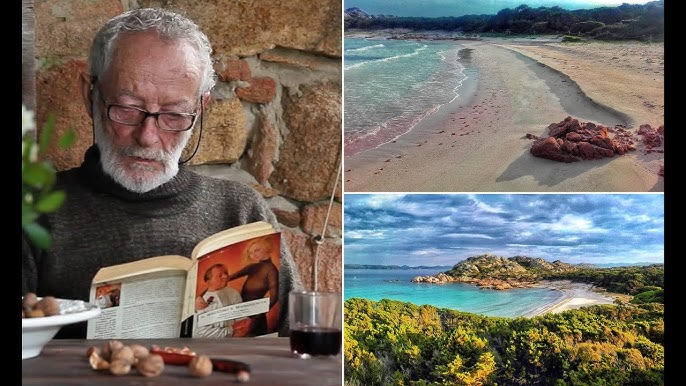
This is the story of Italian, Mauro Morandi, who left his people and society behind to live a life of solitude. Life’s ordinary responsibilities remain too heavy to cast aside. Yet one man did what others only imagine. He left everything behind, found a silent corner of Italy’s waters, and built a life shaped by wind, salt, and solitude. His name is Mauro Morandi, and for eighteen years he lived completely alone on the small island of Budelli, one of the most striking and remote islands in the Maddalena Archipelago of Sardinia.
This is not a tale about escape as much as it is about discovery. It is a story about a man who walked away from noise to hear himself more clearly. For nearly two decades, Morandi served as the island’s quiet guardian. He protected its fragile ecosystem, welcomed rare visitors, and developed a profound relationship with nature that he believed modern society had forgotten.
The world would eventually find him, question him, admire him, and—after many years—remove him. Yet his years on Budelli remain one of the most unusual personal odysseys of the modern era.
What follows is the full account of how a former teacher became the solitary caretaker of a pink-sand island, why he chose that life, and what happened when authorities finally forced him to return to the mainland.
A Life Drifting Toward Change
Before the world heard his name, Mauro Morandi lived a fairly ordinary life. Born in 1939 in Modena, northern Italy, he grew up during a period marked by recovery and reconstruction. Like many of his generation, he believed a practical path would offer security. He became a physical education teacher, a profession centered on structure and routine.
Yet something within him never settled. Though he worked in schools, he felt confined by the expectations that came with his role. Over time, the sense of discontent grew stronger. He longed for silence, simplicity, and the freedom to wake each day without obligation to a schedule or system. The more he witnessed society change—technology speeding life forward, people moving with increasing haste—the more he felt detached from the world around him.
By the mid-1980s, that quiet dissatisfaction had turned into a restless need for change. It was no sudden breaking point but a slow accumulation of moments that made him reconsider the life he was living. Eventually, he bought a small catamaran, deciding that the sea might offer the freedom he could not find on land. His plan was straightforward: sail until he felt renewed.
He did not yet know that this search would lead him to Budelli Island, a place so untouched that it felt as though time itself avoided disturbing it.
The Island That Changed Everything
In 1989, while attempting to sail from Italy toward Polynesia, Morandi encountered rough seas. Seeking shelter, he approached the Maddalena Archipelago, a chain of islands known for their rugged beauty and limited human presence. Among them was Budelli, famous for its “Pink Beach,” a shoreline tinted by tiny fragments of coral and shells.
The island covered a little more than one square kilometer. There were no restaurants, no residential areas, and no permanent community. It was accessible only by boat, weather permitting. The silence was immediate, deep, and unlike anything he had experienced.
When Morandi arrived, he learned that the island’s caretaker was about to retire. The position was unofficial, the salary nonexistent, but the purpose clear: protect Budelli’s fragile environment and maintain the small structures that remained on it. Without hesitation, Morandi offered to stay.
In that moment, a man who had spent years searching for meaning found a place that seemed to speak directly to him. He made Budelli his home.
The First Years of Solitude
Life on Budelli was not romantic. There was no electricity beyond what Morandi could generate himself, no running water except what he collected, and no medical support except what could be reached by boat. Supplies came occasionally, depending on weather and sea conditions. He lived in an old structure once used by park personnel, repairing it bit by bit until it became a simple but functional home.
Most days began before sunrise. The wind moved across the island with a soft rhythm that changed with the seasons. Morandi walked the beach each morning, collecting debris washed ashore. Plastic was an old enemy of the island, and he took it upon himself to keep the coastline clean. He catalogued the small changes he saw in the environment, noticing shifts in the color of the sand, the growth of vegetation, and the patterns of wildlife.
When tourists arrived, he became the island’s informal guide. He explained the origins of the pink sand, the delicate ecology, the species that thrived there, and the need for preservation. Visitors often described him with the quiet respect given to someone who had become part of the landscape itself.
In these early years, solitude was not loneliness. It was a kind of partnership between man and nature. Morandi later said that he never felt isolated because the island offered constant company: the sea, the birds, the seasons, and the unbroken horizon.
A Philosopher in Disguise
As word spread about the solitary man living on Budelli, journalists and travelers began to visit. They expected a recluse or an eccentric, but instead they found someone thoughtful, articulate, and calm. He spoke often about humanity’s disconnection from nature and the need to slow down in order to understand life’s deeper movements.
He read philosophy, kept journals, and photographed the island. He described the sea as a mirror that reflected whatever one brought to it—restlessness, fear, or peace. Many who met him described him as a modern hermit, though he never embraced the title. He saw himself not as someone running from society but as someone moving toward something more meaningful.
Over time, the island shaped him. His movements became quieter, his thoughts clearer. He learned to observe small details that most people would miss: the turning of light at a specific hour, the way the sand shifted after strong winds, the calls of birds that signaled the approach of certain seasons.
He believed that modern society had forgotten how to be still. On Budelli, he rediscovered that skill.
The Island Under Threat
Budelli was part of a protected national park, but its ownership and management remained complicated. In 2013, the island was sold to a private businessman from New Zealand who hoped to use it as a residence. The sale sparked protests across Italy, with many insisting that the island’s ecological significance should place it under full national protection.
During this period, Morandi became a recognizable voice in the debate. He had cared for the island for more than two decades and believed that private ownership would threaten its fragile environment. He petitioned local authorities and spoke to the media, explaining the dangers of introducing development to such a delicate ecosystem.
The battle continued for years. Eventually, the Italian government succeeded in reclaiming the island, ensuring that it would remain under public protection. Yet the victory carried unexpected consequences for Morandi.
With the park back under strict management, officials began to question his presence. He had never been formally appointed, never paid, and never approved under the park’s modern regulations. What had once been tolerated as a unique situation was now classified as unauthorized occupation of public property.
Though he had protected Budelli for years, authorities decided that he could not remain.
The Starting of the End
When park officials informed Morandi that he needed to leave, he refused at first. He argued that his presence had benefited the island and that no one else had the time or dedication to care for it as he had. Many supporters agreed. Online petitions gathered thousands of signatures demanding that he be allowed to stay.
Despite public sympathy, officials held their ground. They argued that the island’s structures needed restoration and that the protected area required strict environmental management. According to them, even Morandi’s quiet existence placed pressure on the ecosystem.
The dispute dragged on for years, with occasional moments of hope followed by disappointment. During this time, Morandi continued his work as usual, walking the beaches, cleaning debris, and welcoming the few visitors allowed to dock.
But in early 2021, authorities made their final decision. They informed him that he must vacate the island permanently.
For the first time in nearly two decades, Morandi faced the end of his life’s chosen path.
Leaving the Island
The day Mauro Morandi left Budelli was quiet. There were no crowds, no speeches, no ceremony. He gathered his belongings, took one final walk along the beach he had tended for so long, and left the island by boat with the same simplicity with which he had arrived.
He moved to the nearby island of La Maddalena, where he settled into a small apartment. Life there was profoundly different. There were neighbors, streets, shops, and daily noise. The shift required patience, but he never expressed regret about the years he had spent alone.
When interviewed after his departure, Morandi explained that he did not view his removal as a failure. Instead, he believed he had completed his purpose. He had protected Budelli during years when no one else cared enough to do so. If the authorities were now ready to assume responsibility, then he could step aside.
Though he lived on the mainland again, he often looked toward the horizon, knowing that the island still existed, still quiet, still standing in the sea like an old friend.
Life After Solitude
In La Maddalena, Morandi continued to speak about the importance of environmental protection. He shared photographs from his years on Budelli and wrote reflections on the lessons he learned. He became something of an unexpected figure: a man who lived in isolation yet inspired thousands around the world.
His story resonated because he had done something many people secretly desire but rarely dare to attempt. He chose simplicity in a world driven by complexity. He chose silence in a culture overflowing with noise. He chose purpose over convenience.
As he explained in one interview, the greatest lesson he learned was that the natural world is never separate from human existence. Those who slow down long enough to observe it may discover insights that technology cannot offer.
Why His Story Still Matters
Mauro Morandi’s eighteen years on Budelli challenge modern assumptions about happiness, fulfillment, and progress. His life is a reminder that purpose does not always lie in achievement or accumulation. Sometimes it lies in caretaking, in stillness, in protecting something fragile because no one else will.
His story also raises questions about the relationship between individuals and protected spaces. While his presence benefited Budelli for many years, environmental laws require consistency and clear management. The tension between personal passion and public regulation remains part of his legacy.
Yet above all, his story continues to inspire because it speaks to a deep human longing for connection—connection with nature, with meaning, and with oneself.
Morandi may no longer live on Budelli, but the island will always carry traces of the man who watched over it for nearly two decades. And the world now carries his story, a quiet testament to the beauty of a life lived with intention.

 Funks Swabbie